Economics of Bike Touring

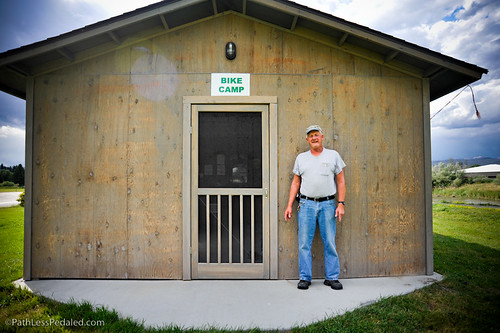
After an eye-opening talk with Bill White, the man who rallied the community of Twin Bridges together to erect the nation’s first ever Bike Camp, we’ve been thinking a lot about bicycle touring and its effects on small towns. He started Bike Camp as a means to get touring cyclists to stay in town and to benefit the local economy. He became enamored with the many stories of passing cyclists but also saw an opportunity for the town of Twin Bridges to benefit from hungry and tired bike tourists riding through.
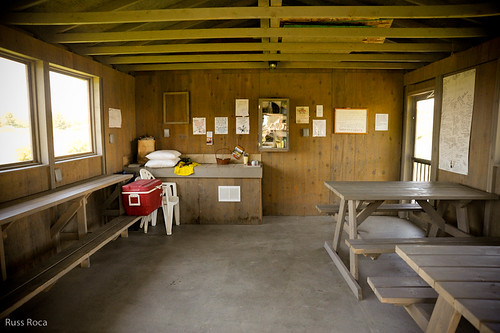
For Bill, it was simple. To not do something to keep the cyclists in town was like “watching gold flow down the river.” So he dreamed up Bike Camp and raised the funds and community support to see it happen. It was such a simple insight, but one that we as bike tourists always clamor for. Show us a modicum of bike friendliness and we’ll be eternally grateful. Heck, we’ll even spend money in your town.

This got me thinking about our spending habits and how it would be different if we were in a car. We’re pretty average as far as touring cyclists, shooting for about 50 miles a day. Far enough to move through the landscape, but slow enough to do some fishing and eat some pie. Because of our limited distance per day and the massive amounts of calories we’re expending a day we eat a lot and require a place to overnight (camp, RV park, motel, etc.,).

I began thinking of how our spending habits would be different if we were driving. Take a 200 mile road trip. It would be easily accomplished within a day in an automobile. You’d probably stop for lunch, refill the gas tank along the way and get dinner and lodging at your final destination. You might pass a handful of small towns along the way, but since you’re moving so fast and not expending any calories, chances are you probably won’t stop unless you have to use the bathroom. Those small towns would just be a blur from inside your car.
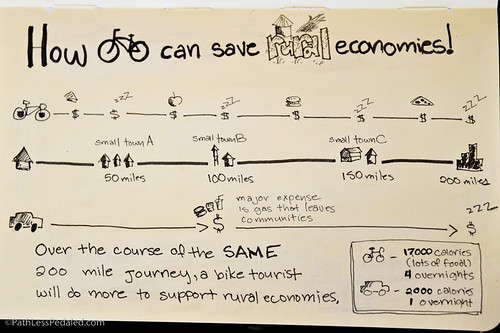
Take that same 200 mile stretch and think of how a bike tourist would move through the landscape. If they’re 50-mile-a-day cyclists like us, they would require 4 nights of lodging or camping. Because we’re constantly burning calories, that same trip would require 12 meals or snacks in between (either cooked with food bought from local markets or meals at the local eateries). We would definitely stop in every town to refill water bottles, stock up on food, use the restroom and spend the night.

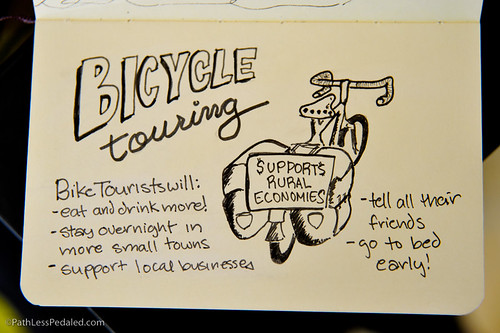
Given the same 200 mile stretch, a touring cyclist will make more of an economic impact on the small towns along the way than a person driving in a car. Now imagine, if small towns across the country welcomed cyclists by offering simple accommodations like the Bike Camp, especially those along Adventure Cycling routes. Not only would it benefit cyclists, but small towns would benefit as well with a constant stream of tired and hungry bike tourists coming through town. The more accommodations, the more people touring, the more people spending money in small towns.
It’s a dream for sure. But after seeing Bike Camp, in Twin Bridges and talking to Bill, we had a momentary glimmer of what bike tourism could be.

19 comments


  • I laughed out loud at “Go to bed early!”

    August 8, 2011
  • Ty Morrison-Heath

    Yesterday while on a touring trip from Talkeetna, AK to Denali National Park we stopped in Cantwell. Out of the paying customers 9 out of 12 were bike tourists. We stop and spend money at small towns so much more often and if people would simply set themselves up to cater slightly to us they would reap the rewards!

    August 8, 2011
  • Andy

    This is precisely the approach used on the Elroy-Sparta trail in Wisconsin, where the stream of cyclists on the approximately 100 mile rail-trail provides an important source of revenue for the small towns (populations of 1500-10,000) abutting the trail.

    August 8, 2011
  • Silvia

    I know when I went cross-country, we were in an independently owned restaurant for breakfast and dinner just about every night! And it’s not just small towns: Utica, NY looks like it has seen better days and it’s on the Erie Canal route. (I was driving through on my way to Cooperstown)

    August 8, 2011
  • David Irvine

    Last Monday 1 Aug while returning to Nashville TN from Elkins WV I made a detour to Damascus VA to ride a few miles of the Virginia Creeper trail on my old beater bike. I stayed at the Lazy Fox B&B where the long-time proprietor Mrs Ginnie Adams, 87, told me that the creation of the 34-mile Virginia Creeper multiuse trail out of the former Virginia & Carolina RR ROW transformed Damascus pulling the town out of decades of economic doldrums. Part of the AT goes thru here too. A friendly town now doing well catering to the needs and interests of visitors using a great trail.

    August 8, 2011
  • [...] to cycle tourists going to and from the Ochoco Mountains and Bend? Or what if there were “bike camps” in the small communities from Bend to John Day, Oregon like the one Russ Roca from The Path [...]

    August 8, 2011
  • Dan

    Down here in New Zealand the government has recognised the economics of this and has helped build some new rides. I think I heard them quote that 50,000 bike tourists visit here each year and their length of visit is much longer than other tourists.If you’re interested here is the webpage

    http://www.nzcycletrail.com/

    August 8, 2011
  • [...] Hand-Drawn Infographic Shows How Bike Touring Benefits Rural Economies (Path Less Pedaled) [...]

    August 9, 2011
  • [...] Bicycle Story interviewee Russ Roca posted an excellent argument on the Path Less Pedaled site about a bike tourist’s economic benefit in a small, rural town, versus that of a car [...]

    August 9, 2011
  • Nate

    Another case in point: the Katy Trail through central Missouri. The Trail follows the Missouri River – not the Interstate. So you have to ask yourself: how many of the small towns along the Trail would ever even SEE a tourist if the Katy hadn’t been built?

    August 9, 2011
  • Steve Cifka

    Russ,
    Wonderul article! Reminds me of some of Wendell Berry’s essays on how small farms benefit communities in similar ways rather than a big industrial fuel dependent mega farm. Have you read his work?
    I think you are really onto something with your new drawing/writing. I would buy and treasure anything you publish!

    August 10, 2011
  • [...] at the Path Less Pedaled blog, Russ Roca writes and illustrates why bicycle touring is better economically for small towns and [...]

    August 10, 2011
  • [...] Worried about the economics of small towns? Bromptonite Russ Roca says tap into bicycle tourism. (Path Less Pedaled) [...]

    August 24, 2011
  • [...] Fact: Cycling Helps Rural Communities Posted on October 11, 2011 by Will var addthis_product = ‘wpp-261′; var addthis_config = {“data_track_clickback”:true};Ok, here’s a real fact today: riding a bike helps rural communities. It’s something that Russ from Path Less Pedaled has laid out pretty clearly. [...]

    October 11, 2011
  • Stuart Knoles

    There may be a “build and they will come” impetus to some degree – for those who have the insight. One extreme fantasy (of mine) could be a self-supported exclusive non-motorized route mutually supporting a variety of levels and modes of lodging, entertainment, dinning, and merchandizing along that route. Although many of the facilities could have access to the outside world, the route itself could be its own world experience. What a trip. A new reason for a small town to be.

    February 27, 2012
  • Great article. Check out RAGBRAI an annual 20,000+ traveling through small towns across. Iowa. Its so much fun, and the boost to the local economies is astounding…my family does it every year.

    Bicycles! FTW!

    February 27, 2012
  • [...] Not only is bicycle travel efficient, it is inexpensive and fun!  And bike touring is an independent way to travel. Alaska suffers from the bane of industrial tourism; tourists are funneled into corporate restaurants, hotels, and venues, making it harder for local tourism businesses to survive and thrive. Touring on bikes supports relocalization. [...]

    June 21, 2012
  • [...] Podcast is currently on tour and emailed us this photo the other day. It is a dry erase board from Bike Camp in Twin Bridges Montana. I made this little sketch and left this note nearly a YEAR ago and [...]

    July 5, 2012
  • [...] has flourished since the Willamette Valley Scenic Bikeway opened for business in 2009. With the economic boost that comes with opening up to bicycle tourism, public and private agencies across Oregon are [...]

    January 31, 2013

Leave a comment


Name*

Email(will not be published)*

Website

Your comment*

Submit Comment

© Copyright The Path Less Pedaled - Designed by Pexeto